
The crypto market has been struggling for months — declining prices, persistent uncertainty, and a macro environment that has made risk assets difficult to hold. In that context, the behavior of participants on the world’s largest exchange has quietly told a story that the price charts have not: when the going gets uncertain, even crypto investors reach for gold.
A CryptoQuant analysis tracking Binance’s tokenized gold reserves has just quantified exactly how significant that shift has been. In early 2025, Binance held approximately 25,301 units of PAXG — the tokenized gold product that gives crypto participants direct exposure to physical gold prices. By early April 2026, that figure had skyrocketed to a peak of 133,334 units. It currently sits at approximately 112,385 in early May. From start to peak, that is a 344% increase in the amount of gold held on a crypto exchange.
The timing of that accumulation is inseparable from what was happening in crypto markets during the same period. As prices declined and uncertainty intensified, a significant cohort of Binance participants was not rotating into stablecoins or exiting to cash. They were moving into gold — the oldest safe-haven asset in financial history — through the infrastructure of the ecosystem they already occupied.
That behavioral signal is worth understanding. It says something specific about where market participants believe safety lives when crypto stops feeling safe.
344% More Gold on a Crypto Exchange. Wall Street Targets $6,300. The Trade Is the Same
The accumulation did not happen in isolation. While Binance’s PAXG reserves were growing 344%, physical gold was completing one of its most significant rallies in recent history — climbing from approximately $2,700 in early 2025 to its January 2026 all-time high of $5,589 before correcting to the current $4,650 level. Crypto participants who moved into tokenized gold during that period were not late to the trade. They were in it.

The institutional perspective on gold’s current correction is uniformly constructive. JPMorgan has set a year-end 2026 target of $6,300. Goldman Sachs projects $5,400. Both institutions characterize the pullback from the all-time high as a strategic entry point rather than a trend reversal. The forces that drove the initial rally — central bank accumulation and geopolitical hedging demand — remain structurally intact and are not considered resolved by a 17% correction from the peak.
What the CryptoQuant analysis identifies in the correlation between PAXG reserve growth and these institutional forecasts is not coincidence. Crypto participants who built their tokenized gold positions throughout 2025 and into 2026 were making the same macro judgment that JPMorgan and Goldman Sachs are now formalizing in price targets. The methodology was different. The conclusion was the same.
The convergence of crypto behavior and Wall Street forecasts around the same asset at the same macro moment is the signal the analysis is pointing toward. When different categories of participants with different frameworks arrive at the same trade, the structural case for that trade tends to be stronger than any single participant’s analysis would suggest alone.
Bitcoin-Gold Ratio Attempts Recovery Within Broader Downtrend
The Bitcoin-to-gold ratio is trading near 17.3 after rebounding from a sharp drawdown earlier this year, but the broader structure remains under pressure. The chart shows a clear rejection from the 2025 highs above 35, followed by a sustained decline that reflects Bitcoin underperforming gold in relative terms.
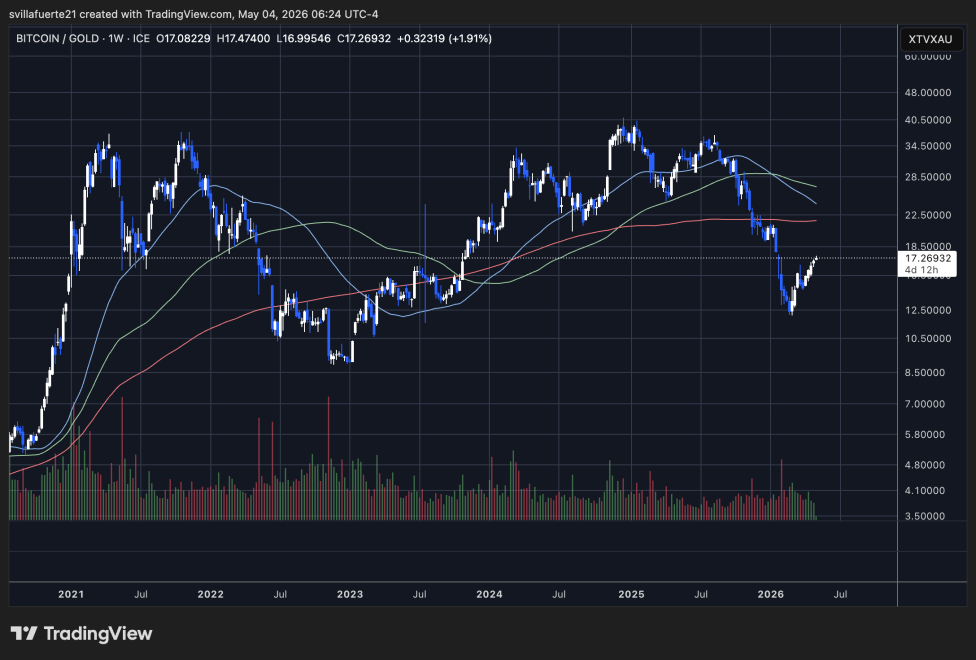
The recent bounce from the 12–13 zone is technically meaningful. That area has acted as a historical support range, and the reaction suggests demand emerges when Bitcoin becomes relatively cheap versus gold. However, the recovery has so far been corrective rather than impulsive.
Price remains below all major moving averages, with the 50-week, 100-week, and 200-week trending downward or flattening. This alignment confirms that the dominant trend is still bearish, and rallies are likely to face resistance as the ratio approaches these levels.
The 17–18 zone now acts as a pivot. A sustained move above it would signal strengthening relative performance and open the path toward the 22–24 region, where prior support turned resistance sits. Failure to hold current levels would suggest the bounce is losing momentum, with a potential retest of the 13 zone.
Structurally, the ratio reflects a market still favoring gold over Bitcoin, with the current move testing whether that dynamic is beginning to shift or simply pausing.
Featured image from ChatGPT, chart from TradingView.com