Tuesday, March 31, 2026
DIGESTWIRE
Contribute
CONTACT US
  • Home
  • World
  • UK
  • US
  • Breaking News
  • Technology
  • Entertainment
  • Health Care
  • Business
  • Sports
    • Sports
    • Cricket
    • Football
  • Defense
  • Crypto
    • Crypto News
    • Crypto Calculator
    • Coins Marketcap
    • Top Gainers and Loser of the day
    • Crypto Exchanges
  • Politics
  • Opinion
  • Blog
  • Founders
No Result
View All Result
  • Home
  • World
  • UK
  • US
  • Breaking News
  • Technology
  • Entertainment
  • Health Care
  • Business
  • Sports
    • Sports
    • Cricket
    • Football
  • Defense
  • Crypto
    • Crypto News
    • Crypto Calculator
    • Coins Marketcap
    • Top Gainers and Loser of the day
    • Crypto Exchanges
  • Politics
  • Opinion
  • Blog
  • Founders
No Result
View All Result
DIGESTWIRE
No Result
View All Result
Home Blockchain

Jordi Visser Says Bitcoin Was Built For This New Fed Crisis

by DigestWire member
March 31, 2026
in Blockchain, Crypto Market, Cryptocurrency
0
Jordi Visser Says Bitcoin Was Built For This New Fed Crisis
74
SHARES
1.2k
VIEWS
Share on FacebookShare on Twitter

Macro investor Jordi Visser is arguing that Bitcoin’s original purpose is coming back into focus as the Federal Reserve faces a new macro trap shaped by debt, oil, slowing growth and weakening employment. In a note published March 30 under the banner “D.O.G.E. 2.0,” Visser says that mix could leave policymakers unable to impose the kind of economic pain a traditional inflation fight would require.

His framework repurposes the acronym into four pressures: debt as the structural constraint, oil as the inflation shock, growth as the casualty of tighter conditions, and employment as the side of the Fed’s mandate that may soon take precedence. The broader claim is not simply that inflation could return, but that it could return in a form monetary policy cannot easily fix.

Why Bitcoin Could Be The Big Winner

Visser’s argument starts with supply-side stress. He points to oil prices rising after the war with Iran disrupted flows through the Strait of Hormuz, while import-price pressures and higher memory-chip costs linked to AI demand were already feeding through global supply chains. “That is what makes this moment dangerous,” he writes. “The inflation problem may be returning, but it is returning for reasons the Fed cannot easily solve, all while affordability remains a major political issue. Rate hikes do not reopen Hormuz. They do not create more DRAM.”

From there, he shifts to what he sees as the crucial difference between today and the 1970s. Back then, Visser notes, federal debt stood near 35.5% of GDP in 1970 and around 31.6% by 1979. Today, he says, the comparable figure is about 122.5%. That changes the amount of pain the system can absorb. In his telling, the United States is confronting the possibility of a second inflation wave with a debt burden roughly four times heavier than at the end of the last major oil-driven inflation era.

He makes the same point through asset valuations. The stock-market-capitalization-to-GDP ratio, he argues, is now above 200%, versus roughly 42% in 1975 and 38% in 1979. In practical terms, that means a determined inflation fight would not only hit a more indebted fiscal structure and a more fragile Treasury market, but also a far more financialized economy. “This is not just a replay of the 1970s,” Visser writes. “It is the 1970s problem inside a far more levered system.”

The labor side of the equation is equally important in his thesis. Visser points to a February 2026 employment report showing nonfarm payrolls down 92,000, unemployment at 4.4%, and payroll employment having changed little on net in 2025. Wage growth, he says, has also eased materially from its 2023 peak. That backdrop matters because it makes a renewed inflation offensive harder to justify politically and economically than it was during the post-COVID tightening cycle.

Visser argues the Fed has already begun preparing markets for that distinction. He cites Chair Jerome Powell’s March 18 press conference, where Powell acknowledged higher energy prices could lift inflation in the near term while reiterating that central banks often try to “look through” energy shocks if inflation expectations remain anchored. Visser also notes Vice Chair Philip Jefferson’s warning that persistently higher energy prices could weigh on both inflation and spending, intensifying the Fed’s dual-mandate dilemma.

That is where Bitcoin enters the story. Visser ties the current setup back to Bitcoin’s creation during the 2008-09 financial crisis, arguing that Satoshi Nakamoto’s design was a direct response to a monetary system dependent on bailouts, intervention and expanding guarantees when stress becomes intolerable.

“Bitcoin was born as a response to a system in which governments and central banks could always create more money, extend more guarantees, and socialize more losses when the structure became too fragile to endure discipline,” he writes. “Whether you view that as protest, timestamp, or both, the message was unmistakable.”

His conclusion is that Bitcoin does not require hyperinflation to validate that thesis. It only requires markets to believe that each inflation fight will be shorter, each easing cycle will arrive sooner, and each downturn in a debt-heavy system will push policymakers back toward accommodation.

At press time, Bitcoin traded at $66,466.
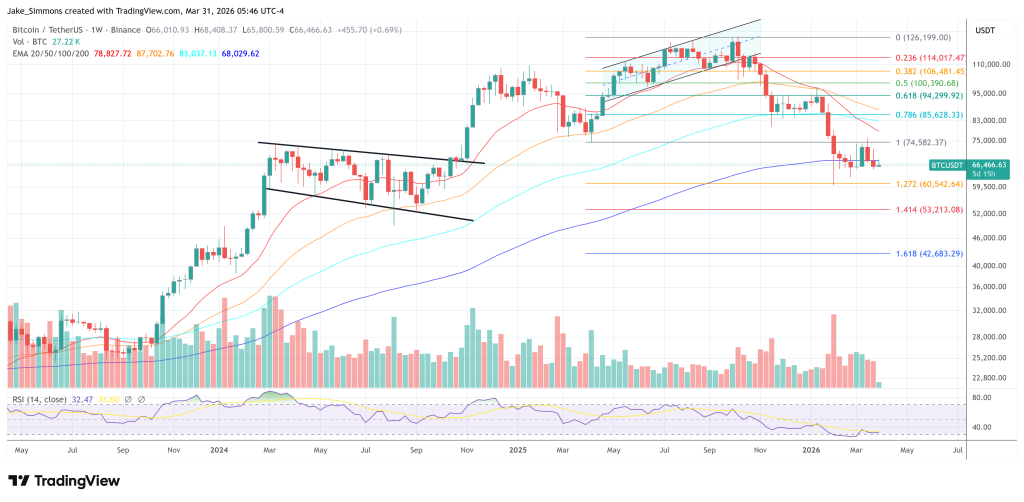
Bitcoin price chart

Read Entire Article
Tags: BlockchainCoin Surgesnewsbtc
Share30Tweet19
Next Post
What business cost increases are being introduced in April?

What business cost increases are being introduced in April?

Tiger Woods had pills in his pocket and bloodshot eyes after crash, report says

Tiger Woods had pills in his pocket and bloodshot eyes after crash, report says

Houlton men who sued over security cameras say town still withholding information

Leave a Reply Cancel reply

Your email address will not be published. Required fields are marked *

I agree to the Terms & Conditions and Privacy Policy.

No Result
View All Result
Coins MarketCap Live Updates Coins MarketCap Live Updates Coins MarketCap Live Updates
ADVERTISEMENT

Highlights

Jordi Visser Says Bitcoin Was Built For This New Fed Crisis

Iran Signals Diplomatic Opening on US-Israel War With Strict Non-Negotiable Conditions

The “White Lotus” Season 4 Cast Is So Ridiculously Stacked — Check Out The Full List

Cardano Midnight Fork Launches Privacy Layer as Pepeto Draws Entries While SUI and PEPE Hold

Schiff Warns US Dollar Credibility Collapse Could Trigger Rising Rates, Debt Crisis, and Economic Downturn

Is Ripple Moving Away From XRP? The Convera Deal Raises Questions

Trending

Breaking News

Houlton men who sued over security cameras say town still withholding information

by DigestWire member
March 31, 2026
0

The allegations come on the heels of months of public unrest late last year.

Tiger Woods had pills in his pocket and bloodshot eyes after crash, report says

Tiger Woods had pills in his pocket and bloodshot eyes after crash, report says

March 31, 2026
What business cost increases are being introduced in April?

What business cost increases are being introduced in April?

March 31, 2026
Jordi Visser Says Bitcoin Was Built For This New Fed Crisis

Jordi Visser Says Bitcoin Was Built For This New Fed Crisis

March 31, 2026
Iran Signals Diplomatic Opening on US-Israel War With Strict Non-Negotiable Conditions

Iran Signals Diplomatic Opening on US-Israel War With Strict Non-Negotiable Conditions

March 31, 2026
DIGEST WIRE

DigestWire is an automated news feed that utilizes AI technology to gather information from sources with varying perspectives. This allows users to gain a comprehensive understanding of different arguments and make informed decisions. DigestWire is dedicated to serving the public interest and upholding democratic values.

Privacy Policy     Terms and Conditions

Recent News

  • Houlton men who sued over security cameras say town still withholding information March 31, 2026
  • Tiger Woods had pills in his pocket and bloodshot eyes after crash, report says March 31, 2026
  • What business cost increases are being introduced in April? March 31, 2026

Categories

  • Blockchain
  • Blog
  • Breaking News
  • Business
  • Cricket
  • Crypto Market
  • Cryptocurrency
  • Defense
  • Entertainment
  • Football
  • Founders
  • Health Care
  • Opinion
  • Politics
  • Sports
  • Strange
  • Technology
  • UK News
  • Uncategorized
  • US News
  • World

© 2020-23 Digest Wire. All rights belong to their respective owners.

No Result
View All Result
  • Home
  • World
  • UK
  • US
  • Breaking News
  • Technology
  • Entertainment
  • Health Care
  • Business
  • Sports
    • Sports
    • Cricket
    • Football
  • Defense
  • Crypto
    • Crypto News
    • Crypto Calculator
    • Blockchain
    • Coins Marketcap
    • Top Gainers and Loser of the day
    • Crypto Exchanges
  • Politics
  • Opinion
  • Strange
  • Blog
  • Founders
  • Contribute!

© 2024 Digest Wire - All right reserved.

Privacy Policy   Terms and Conditions

This website uses cookies. By continuing to use this website you are giving consent to cookies being used. Visit our Privacy and Cookie Policy.