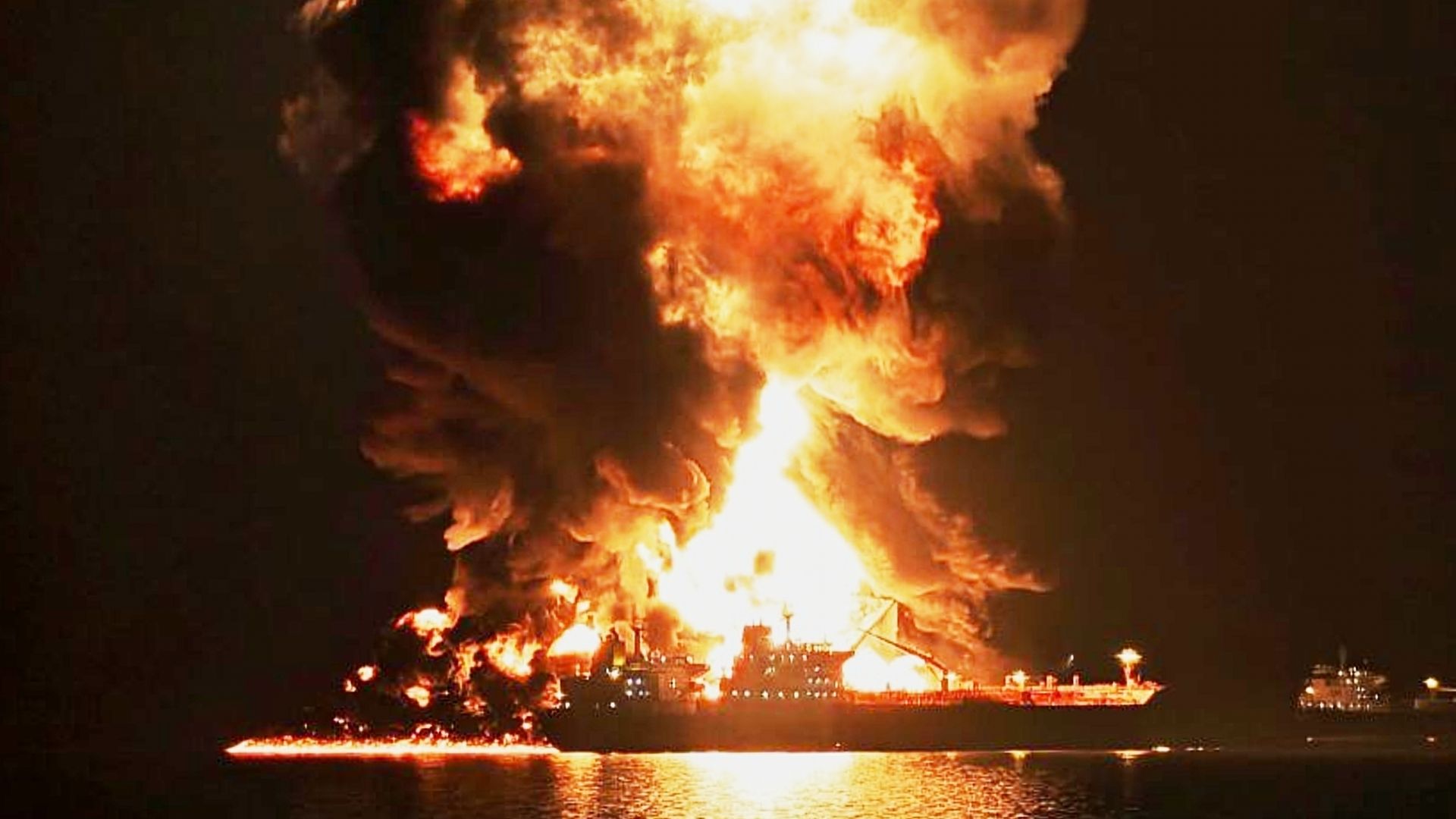
The fear of mines laid by submarines, kamikaze drone boats and GPS jamming have effectively closed the Strait of Hormuz.
Iran has long threatened to shut the narrow waterway through which 20% of the world’s oil supplies passes, knowing that doing so would cause market havoc and send prices soaring. This is effectively what has now happened.
At least 16 ships have been hit by Iran since the conflict began, with Tehran releasing a video (below) of what it claims is the moment an oil tanker was attacked off the coast of Iraq – with devastating consequences.
Now, 3,000 ships and around 20,000 crew are trapped or affected in the region, the International Maritime Organisation says.
So what tools and weapons is Iran employing in its blockade of the crucial trade route – and what is it holding back for later?
Sea drones
The threat of sea drones has long been a feature of the war in Ukraine, and the tactic is now being used in the Persian Gulf.
Sea drones, sometimes called USVs (unmanned surface vehicles), are small, unmanned vessels that operate on or below the water’s surface, making them difficult to defend against, particularly at night.
In January last year, footage released by the Iran’s Islamic Revolutionary Guard Corps (below) purportedly shows such craft in an underground tunnel.
Naval drones laden with explosives have reportedly been used in at least two attacks on oil tankers in the region since the war began.
Follow live: Iran war latest
On 1 March, a crude oil tanker was hit 44 miles off the coast of Oman, killing one crew member.
Days later, the Bahamas-flagged crude oil tanker Sonangol Namibe was hit near an Iraq’s Khor al Zubair port.
Video posted online shows what resembles a naval drone slamming into the side of the ship, triggering an explosion that sent plumes of smoke into the sky.
Alicja Hagopian with Sky News’ data and forensics team reports that Iran has attacked at least 16 vessels around the Strait of Hormuz and the wider Gulf.
Six ships are reported to have been struck since early Wednesday alone, the most intense period of naval strikes by Iran so far.
Iran has also suffered significant casualties at sea, with reports of 87 deaths after the US sunk an Iranian warship off the coast of Sri Lanka last week.
Meanwhile, Iranian UAVs (unmanned aerial vehicles), or flying drones, have also been seen. Dr Sidharth Kaushal from the RUSI thinktank told Sky News that they may pose a lower risk to the actual ships, but are a danger to their crews and have a psychological impact.
Is Iran deploying mines in the Strait of Hormuz?
The possibility of Iran deploying anti-ship mines to the Strait of Hormuz has come increasingly into the spotlight as the war has continued.
Made infamous through their use in huge minefields in the Second World War, these weapons would pose a grave threat to ships passing through contested waters.
Iran has some “contact mines”, according to Dr Kaushal.
But a more sophisticated threat comes in the form of mines that can lie in wait for ships on the seabed. When a vessel passes above them it is detected by a sensor and then the mine releases a torpedo-like charge, Dr Kaushal says.
These mines could be laid by ships – though these would likely to be targeted by US-Israeli strikes – or by so-called “midget submarines”.
The submarines are based on a model from North Korea and can be used to clandestinely lay mines.
Follow our channel and never miss an update.
It’s unclear how many mines – if any – have been laid in the Strait of Hormuz.
Dr Kaushal cited reporting from American sources that suggests “a small number – dozens so far” had been deployed. Sources told the Reuters news agency that Iran had deployed about a dozen mines and that most of the locations were known.
Stocks of anti-ship missiles
“What the Iranians haven’t used much thus far is their arsenal of anti-ship missiles,” Dr Kaushal says.
These include the Iranian variant of the C802 Chinese ballistic missile or the home-produced Kheibar Shekan missile.
“They have kind of achieved their strategic aim for now,” Dr Kaushal says, referring to the fact that the Strait of Hormuz is effectively closed.
This might change if there was an attempt to have commercial vessels pass through the waters escorted by warships.
“If there is an effort to force the Strait with naval forces I think some of the capabilities might be more relevant.”
The US has refused near-daily requests from the shipping industry for military escorts through the Strait of Hormuz since the start of the war, saying the risk of attacks is too high for now, sources told Reuters.
Not just Iran carrying out GPS jamming?
The issue of GPS – or, more correctly called GNSS (global navigation satellite systems), jamming – is increasingly an issue for airplanes and ships worldwide.
And the Strait of Hormuz has been a hotspot for electronic interference since before the conflict broke out.
While it can be used to antagonise adversaries, it’s often used as a defence measure against drones.
Dr Ramsey Faragher, director of the Royal Institute of Navigation, told Sky News that multiple countries may be using the technology in the Gulf.
“It’s probably a combination of Iran possibly turning up and turning on more of its own interference sources,” he said. “But also I suspect neighbouring countries have now turned on some of their own in order to try to defend against the drone strikes.”
Disrupting navigation signals is one of the “cheapest and effective first lines of defence” against drone attacks, he says.
A look at a map of known GPS jamming in the region appears to show hotspots over Oman and the UAE, which are among the countries targeted by Iran since the conflict broke out.
On VesselFinder, which tracks ships worldwide based on their location transmissions, huge clusters of boats in oddly geometric shapes can be seen. This is likely to be a result of GPS interference and not indicative of their actual positions.
Dr Faragher added: “It’s definitely one of the most active spots in the world right now for electronic interference and that’s impacting, as we all know, not just maritime shipping and commercial shipping but it’s impacting all of the aircraft that fly nearby that region as well.”