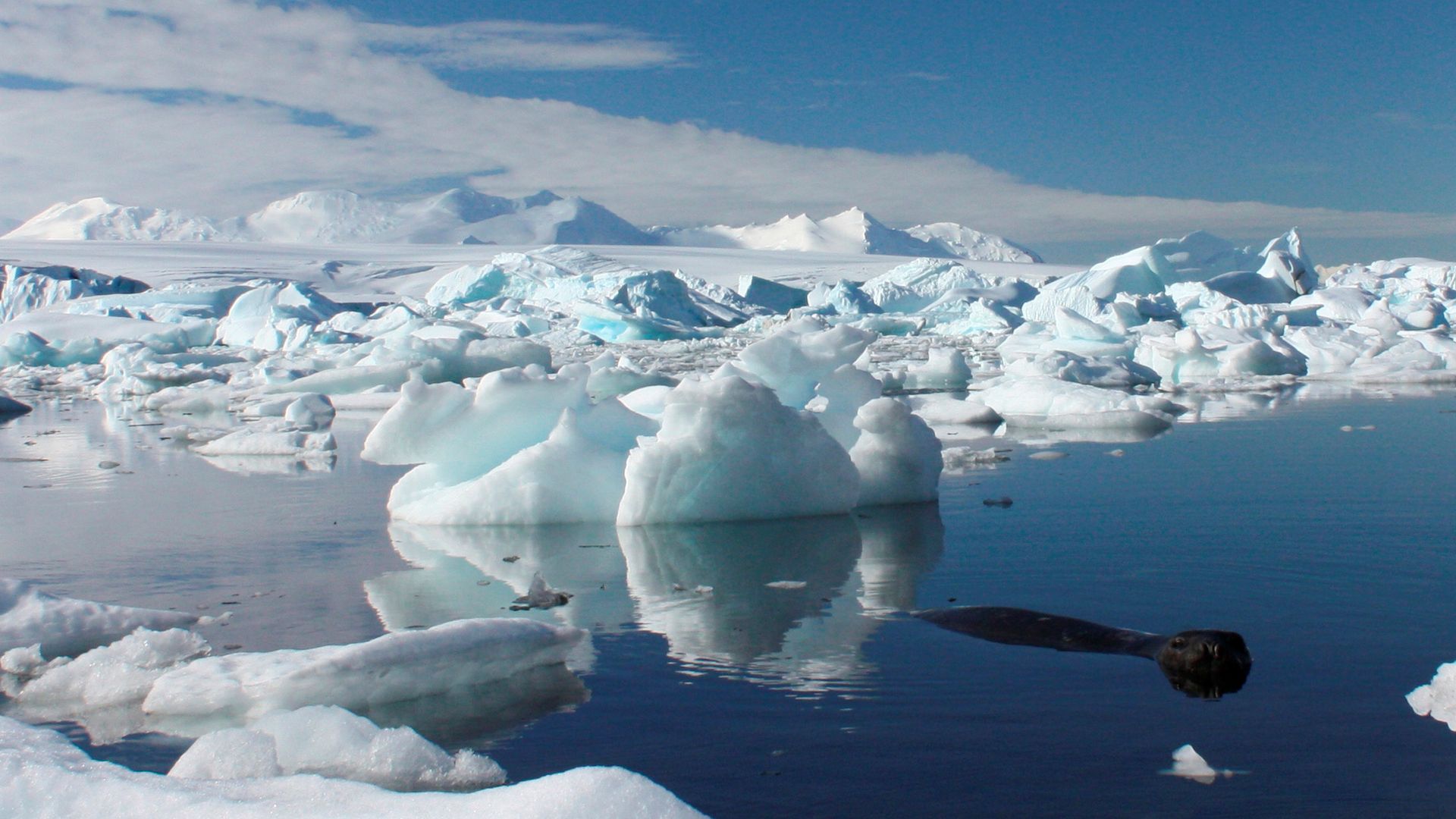
Even though it’s high summer in the Antarctic, the ocean around the Rothera research station is -1 Celsius.
As some of the most productive oceans on the planet – a soup of microscopic plant and animal plankton – it’s murky to boot.
Not everyone’s idea of the perfect scuba spot.
But the divers I’m with seem positively excited about tipping themselves backwards into the depths.
“You can get these big starfish with 40 arms that you don’t see anywhere else, they’re my favourites,” said Pati Glaz, a marine biologist with the dive team of the British Antarctic Survey (BAS).
For her dive partner, BAS marine biologist Matt Bell, it’s “polar gigantism” that floats his boat.
No, me neither.
Is Antarctica a time bomb for Trump?
Is America surrendering Antarctica to its rivals?
Mad science or a last hope? The researchers trying to repair the climate
It’s the phenomenon, he patiently explains through a thick neoprene helmet, of species exclusive to cold polar oceans growing much larger than their cousins in warmer waters.
The colder the water, the more oxygen it can carry, and the more animal you can grow.
“Because it’s cold, the biology is very different,” said Professor Lloyd Peck, who leads marine biology research at BAS.
“Things live a long time,” he said.
In a rapidly warming Antarctic, that’s not necessarily a good thing.
Animals down here live long, partly because they grow and reproduce slowly.
An Antarctic starfish can take hundreds of days to reproduce compared to a few weeks for its cousins in the UK. Warm things up by just a degree or so, and their larvae hatch earlier, in the winter, say, when there’s no food and no light.
“We’re really worried that many species could fail because the timing of their cycles is changed in a very detrimental way, by just a small amount of warmth,” said Prof Peck.
The key strength of their dive research is they’ve been surveying the same sites on the seabed for nearly 30 years.
Important, if you want to judge the winners and losers in an ecosystem that’s already close to a degree warmer on average than when research here began.
But diving in Antarctica is not without complications.
As well as specialist dry suits and very thick gloves, before the divers go in, spotters on the surface to check for wildlife.
Predatory leopard seals, common in these waters, prefer penguins. But their jaws are powerful enough to take a seal, or a similar-sized diver.
Following a fatal encounter in 2003, if leopard seals or curious killer whales are spotted anywhere in the vicinity, before or during a dive, it’s immediately aborted.
After 20 minutes down, the divers return looking surprisingly warm and cheerful. They carry samples of wildlife to take to their laboratory aquarium.
The warming in Antarctica gives a sense of urgency to the research.
They’re not just interested in understanding how marine ecosystems are coping with climate change.
They want to use new techniques to understand sub-zero biology.
Something that at a cellular and molecular level, science knows practically nothing about.
“If you take the cells of animals that live at warmer temperatures and you cool them down to zero degrees, they don’t work,” said Prof Peck.
Biologists suspect there are many factors at play. But one of particular interest, is how proteins fold and stick together.
Cool down a warm-water animal and its proteins stick together. A problem that evolution has obviously solved to allow life to exist in freezing oceans.
“Understanding why our animals don’t have problems with their proteins sticking together will shed light on those mechanisms,” said Prof Peck.
And they may turn out to be very useful to medicine. Diseases like Alzheimer’s and CJD are caused by proteins abnormally sticking together in the brain.
Read more:
Why Antarctica’s underwater tsunamis are alarming scientists
Is America surrendering Antarctica to its rivals?
Be the first to get Breaking News
Install the Sky News app for free
Keep up with all the latest news from the UK and around the world by following Sky News
Growing slowly, but healthily in a high-oxygen environment, could also shed light on the molecular basis of ageing in humans.
His team have just begun a new collaboration with the Centre for Engineering and Biology to develop microscopes capable of operating in sub-zero temperatures to explore the below-freezing biology for the first time.
Back on the dive boat, there are other reasons to be optimistic.
Whales, once a rare sight at Rothera, are all around us.
They count at least 30, possibly 40 humpback whales in the bay, a new record.
Populations are recovering after the ban on whaling 40 years ago.
Receding sea ice has also allowed whales swim here for the first time in millennia.
How ocean ecosystems respond to warming is important.
In the past, they absorbed so much carbon from the atmosphere that they helped usher in ice ages after periods in geological time when Antarctica was even warmer than today.
Fossilised palm trees on the continent speak to that fact – one often championed by those sceptical of climate change.
But Antarctica appears to be warming far faster than it did in aeons past; at a pace its slow, cold biology may struggle to match.