Space is an alien environment for humans.
Our bodies are built for gravity; take it away and there are profound changes to our biology.
Muscles and bones that keep us upright on Earth become weak.
Body fluid that’s normally pooled in our legs floods into our upper body, changing the shape of the heart and damaging the eyes.
And genes that are inactive on Earth suddenly switch on.
Others go silent.
These are some of the lessons learned from 25 years of studying astronauts living and working on the International Space Station (ISS).
And they are challenges that scientists must do their best to overcome as humans embark on a new era of space exploration, venturing beyond the relative safety of Earth’s orbit for the first time in more than half a century.
Overcoming the bodily challenges of space
Four astronauts will launch on a test flight around the moon within weeks.
They will pave the way for future missions that will land on the surface and ultimately build a long-term presence, searching for ice and minerals.
British astronaut Tim Peake knows all about the rigours of microgravity. He spent 186 days in orbit.
“Effectively, you’re taking relatively fit, healthy individuals and you’re putting them through a 20-year aging process in a period of about two months,” he told me.
“Then you’re watching that reverse when they come back to Earth again.”
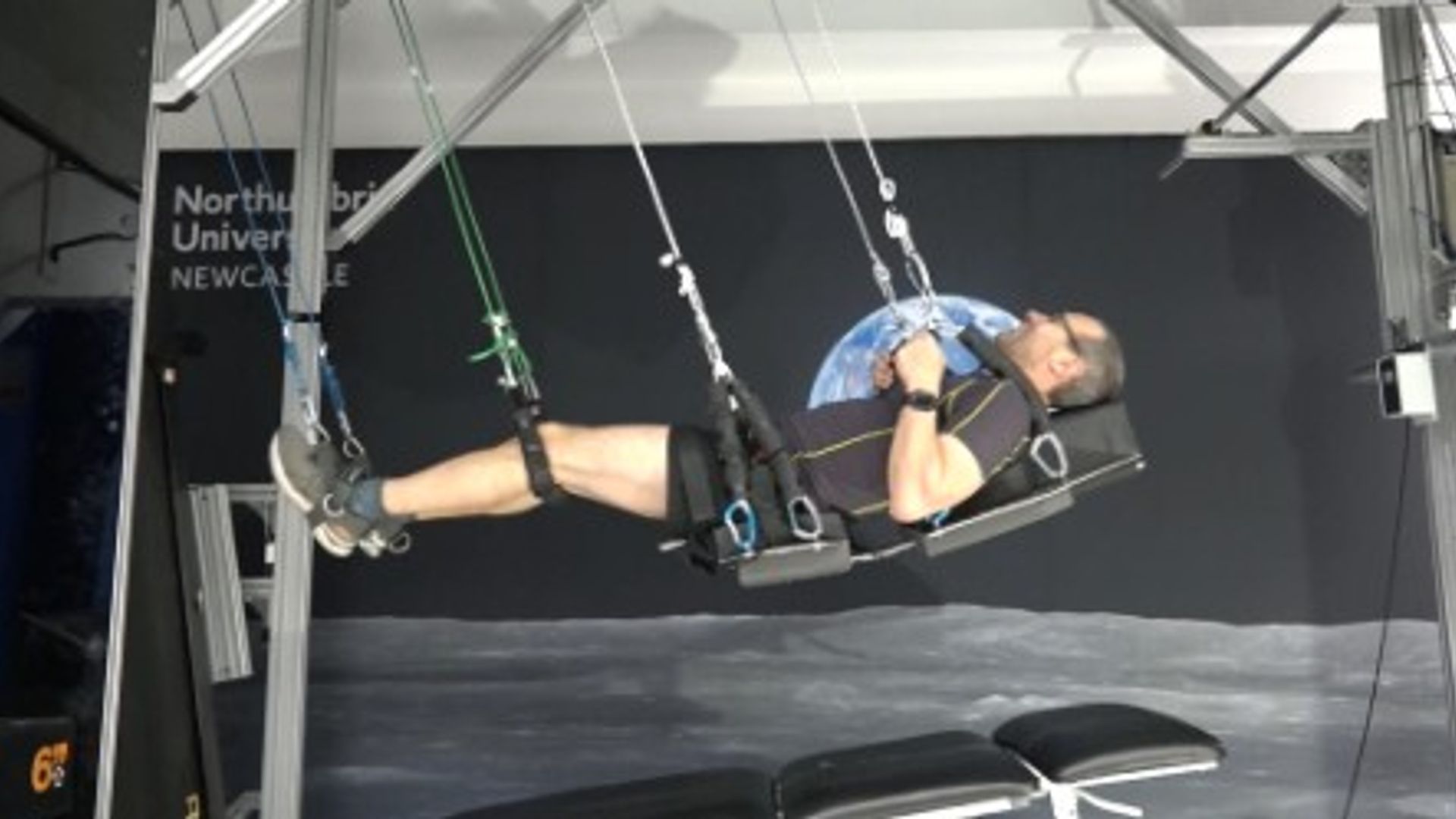
The University of Northumbria has an aerospace medicine laboratory, where scientists are trying to find ways of helping humans adapt to space travel.
In one corner there is a scaffolding rig – what the team calls a “variable gravity suspension system”.
Once attached to its strings, you dangle like a puppet, lying almost horizontally with feet resting on a treadmill that’s fixed in an upright position, as if on a wall.
And it is the closest thing on Earth there is to walking on the moon.
You immediately realised why astronauts in those old Apollo-era movies bounce or lope across the lunar surface.
The moon’s gravity is one-sixth of the Earth’s and if feels natural to take giant strides. It’s exhilarating.
The scientists use the suspension system to study how the muscles and skeleton move without gravity – and then develop exercises that could prepare astronauts for a mission and rehabilitate them on their return.
How quickly is the human body affected?
According to Professor Nick Caplan, head of the laboratory, astronauts on the space shuttle missions of the 1990s began to lose muscle mass and strength in as little as 14 days.
“On longer duration missions, the amount of muscle loss if somebody wasn’t doing any exercise can be anywhere between 5% and 18%,” he said.
And bones in the lower half of the body also get weaker if they don’t have to bear weight.
The effect can be profound, said Prof Caplan.
“For a six-month mission in space, on average we see a similar amount of bone loss as we see across 10 years as part of a normal ageing process in someone down here on Earth,” he said.
The musculoskeletal impacts of microgravity are why astronauts on the ISS exercise for two hours a day. There are weights for strength training and a treadmill for a cardio workout.
Running in space isn’t comfortable. It requires a shoulder harness to hold astronauts down on the treadmill. Yet somehow Tim Peake managed to run a distance equivalent to the London Marathon in 3 hours 35 minutes.
👉 Listen to Sky News Daily on your podcast app 👈
The exercise is a huge time commitment. Scientists at the University of Northumbria are trying to reduce the amount that astronauts need to do.
One strategy is to use an inflatable cuff that is wrapped around the arms or legs. It acts as a tourniquet, restricting the flow of blood and oxygen to the muscles.
Read more from Sky News:
The illegal settlement filling Palestinians with dread
How the Black Death could have spread so fast
Luke Hughes, the lab’s exercise physiologist, sets me up with the cuff and hands me a 2kg weight to do some bicep curls.
It’s far less than I would normally lift, but it quickly pushes my muscle to exhaustion.
Dr Hughes said the system was tested by astronauts on the SpaceX Fram2 mission earlier this year and is being optimised for further testing in future.
“It could make exercise more efficient in space.
“As we move on from the International Space Station to Lunar Gateway (a planned future space station orbiting the Moon), lunar habitats, and then eventually on to Mars, we can’t take all the big, heavy, bulky exercise equipment that’s currently used on the ISS,” he said.
“We need ways to make exercise efficient and optimise it, and this arguably is a leading candidate to do so.”
There is perhaps an even bigger issue that still needs to be solved.
Another invisible danger
When astronauts leave the protective bubble of the Earth’s magnetic field, they will be vulnerable to cosmic and solar radiation.
High energy particles from the sun or from outside our solar system can raise radiation levels by as much as 150 times above those on Earth, damaging DNA and increasing the lifetime risk of cancer.
If there is a solar flare while the Artemis astronauts are travelling to the Moon, they will shelter in an area of the Orion capsule that’s protected by the heatshield as well as containing water tanks and food stores.
But there’s still some exposure.
“It’s only three to five days to get to the Moon, so those missions won’t present a significant risk,” said Professor Caplan.
“But if we think more into the future when we’re sending humans to Mars, we’re looking at a six to nine, maybe 12-month transit time.
“That amount of time will present a significant health risk to those astronauts.
“There are notions about having a metre thick layer of water around the spaceship, which would provide shielding from the radiation.
“But another way that is being looked at is through nutritional factors. Can we reduce the risk of radiation exposure through specific diets?
“There’s a huge amount that is still left to be understood.”
There’s no doubt the Artemis astronauts heading to the Moon are better prepared and better protected than those in the Apollo era.
The ISS has been a big part in that. But there are still huge gaps in our knowledge of how to survive in space.