“I had never seen tanks before.”
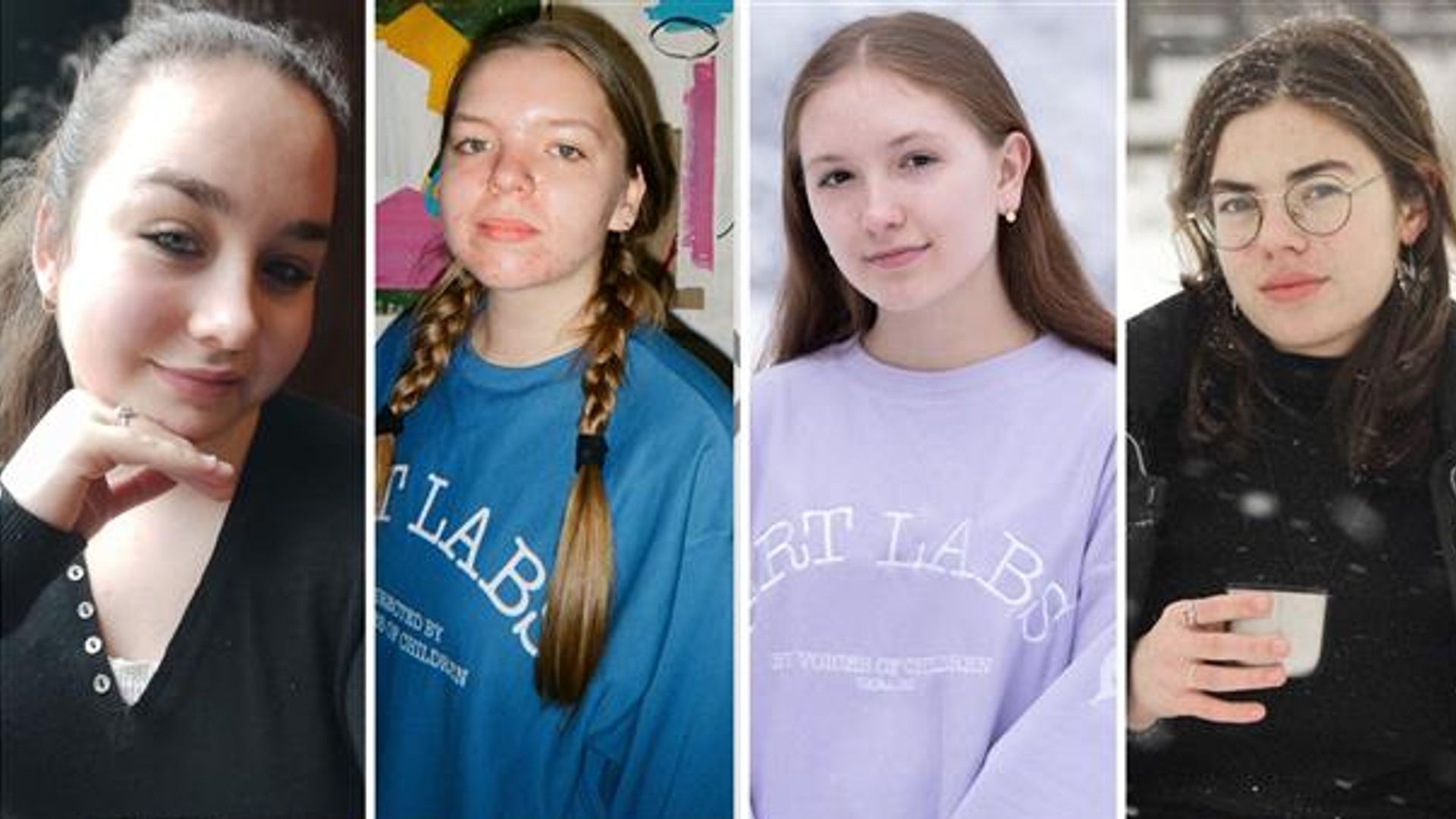
As Ukraine marks the fourth anniversary of the full-scale Russian invasion, Sky News has partnered with Voices of Children, a Ukrainian charity, to tell the stories of teenagers living through war.
They speak of a childhood stolen, and the pain left behind by losses and sacrifices.
Kateryna
I am 14 and I live in Chernihiv, a city in the north of Ukraine near the border with Belarus. In February 2022, I was 10 and couldn’t imagine what war really meant, yet by 22 February my emergency suitcase was packed.
Within days Ukrainian tanks were driving down our street. I had never seen them before. For the first three nights, we slept in the basement. During the day, we counted explosions, and at night, we tried to sleep.
On 4 March, my birthday, we had to leave the city, because Chernihiv was under constant attack from Russian bombers. We travelled for three days, spending the first night with kind people in Brovary, who had taken in the cats and dogs left behind by fleeing families.
The next night was near Khmelnytskyi, where at a checkpoint we were told to stop only in dark places because Russian helicopters might be flying overhead. On the third night, we slept in a kindergarten building on the other side of the country. My family and I stayed there for 40 days before we could go home. It was the hardest time of my life.
Today, the most important thing in my life is creativity, especially writing poetry. I fell in love with literature thanks to my literature teacher, who I can always turn to for help. Writing has become a form of therapy for me.
I do not have many close friends, but I know there are people who help me stay strong, with whom I can talk about everything that worries me. I believe that is important.
Follow our channel and never miss an update.
Hanna
I’m 17 and I’m from Zaporizhzhia.
In September 2022, a missile hit my building. It was deeply traumatic for me. Everyone survived, but coming to terms with it was extremely hard. The experience pushed me to act because the threat should not destroy my sense of purpose.
Over these four years, I discovered volunteering, civic engagement, various projects and the cultural life of our city. Most importantly, I’ve met an incredible number of amazing people who inspire me every day.
Perhaps, without that terrible shock and the acute awareness of my own mortality, my life would have taken a completely different direction. Would I want Russia’s full-scale invasion never to have happened, never to have touched my life? Of course. But I am learning to live in the reality we face and not to let it stand in my way.
Despite all the difficulties, the celebration must go on.
My Valentine’s Day, for example, was bright and eventful. In the morning, I got on a bus and read a message: my friend wouldn’t be coming to the event because her parents wouldn’t let her go due to the security situation. Drones were buzzing in the background, but I hardly reacted. I’m used to it.
At a modern venue that also serves as a bomb shelter, I immersed myself in an educational training session. I was surrounded by young people full of ideas, eager to change the system, launch their own initiatives and move the city forward.
Time flew and soon I had to rush off. I was one of the organisers of an art exhibition, and that day was the opening. I caught up with my friend Yasia, and we hurried towards the gallery. Even in our haste, we noticed the contrasts of Zaporizhzhia’s streets: a clinic destroyed by a strike, buildings nearly reduced to ruins, memorials to the fallen… And right beside them, a cafe was open. Its owners needed only a week to rebuild after a horrific attack.
Read more:
Meet the Ukrainian who swapped Wall Street for the frontline
The ‘hero city’ 30,000 Russians failed to take
Veronika
I am 16. I lived under Russian occupation for two years in my hometown of Melitopol after the full-scale invasion before my family managed to escape.
The first month under occupation was especially hard. Food was scarce, and what little there was became extremely expensive. It was impossible to buy even basics like bread. My parents and I decided I would not attend a Russian school. My mother, a teacher, also refused to work for the occupation authorities. Because of that, we had to hide. I secretly continued studying at a Ukrainian school online.
We also had to hide every trace at home of my brother, who had gone to fight for Ukraine on the first day of the war.
I don’t have many memories left from the occupation, but I can picture the Russian soldiers, their military vehicles and the aircraft, so many aircraft. My grandparents’ cottage is near an airfield, and throughout my childhood, I loved watching planes arrive. All the helicopters that landed during the occupation had the letter “Z” painted on the side.
The chance to leave Melitopol came through carriers who gathered people in groups and took them across Russia. Before we left, we erased almost everything from our phones – messages in Ukrainian, any mention of my brother.
Half of our group came from Mariupol, so the vehicle stopped to pick them up. It was 2023. I had never seen anything worse in my life than the destroyed Azovstal plant and the Mariupol Drama Theatre, which the Russians were rebuilding. That was the same theatre they had bombed, killing so many people.
At the border, our phones were taken away. My mother was led in for questioning, and I, a child, was left waiting alone in the middle of the customs hall. Finally, at the Latvian border, I remember hearing my native Ukrainian language and feeling a sense of calm.
We moved to Zaporizhzhia. This is where my brother stays when he is on leave. Before the war, the journey here from my hometown took two hours. Now it takes four days and involves crossing three European countries.
I hate how we’ve got used to war. How I have grown used to explosions and air raid alerts that can last for 10 hours. It has become the background of life, a new reality in which we try to make plans for the future. But at the same time, I have realised that there is one thing I cannot get used to: loss.
Today, I was returning home when I saw yet another convoy carrying fallen soldiers. People who passed by stopped and bowed their heads. In that moment, I felt not only pain, but gratitude. Gratitude that we still care. That we do not just drive past. That even as we adapt to war, we do not become indifferent to human grief.
Liza
I’m 18 and I’ve lived in Kyiv for the past two years.
I’m trying to build my life here, but my real home is Oleshky, a small town in the south of Ukraine, in the Kherson region, that is now occupied by Russians. We left to survive. Our neighbours were killed by a shell, and back then, in January 2024, there was no one left in the town to help – no firefighters, no doctors.
We travelled for four days through 20 Russian checkpoints. At a checkpoint in the town of Novoazovsk, my mother and I were taken off the bus for “filtration”. Russians questioned us for four hours.
We started our lives in Kyiv from scratch. We arrived with nothing – just three bags between my sister, my mother and me. But in Kyiv, I met people from my hometown and made new friends. I was able to continue my studies.
Be the first to get Breaking News
Install the Sky News app for free
Yet I still can’t quite get used to this big city. The first thing I do when I wake up is open the news to check what happened overnight. Then I wash my face. If I’m lucky, there’s warm water and electricity. I have breakfast and log into my lectures. I’m studying psychology. I pay for my education myself. After classes, I work as a cashier, because I already know that nothing comes easily.
During my first year in Kyiv, I felt a sense of relief. Here, I’m not scared to walk outside. You can wear make-up and dress the way you want without fearing Russians would target you just because you’re a girl. Back home, when we went to the store, we put on old clothes and hats so we wouldn’t appear attractive to them. Here, there’s no need to hide in a closet as we did in Oleshky when we heard strangers approaching our home. We continued studying online at a Ukrainian school at our own risk, knowing that at any moment we could be forced to attend a Russian one.
In Kyiv, I still have to hide from Russians – in bomb shelters during their attacks. I’ve grown used to the explosions, so I try to fall asleep before the air raid sirens go off, just to avoid hearing them and get some rest. What’s harder to get used to is what comes after the strikes. When the electricity and heating are cut off, it feels like deja vu. In the last months of our life under occupation, in the cold winter of 2024, we also had no power, gas or water.
No matter how hard it was there, leaving home was unbearably painful. I cried and kept repeating that I just wanted the war to end. That is still my greatest wish. I just want to go home.