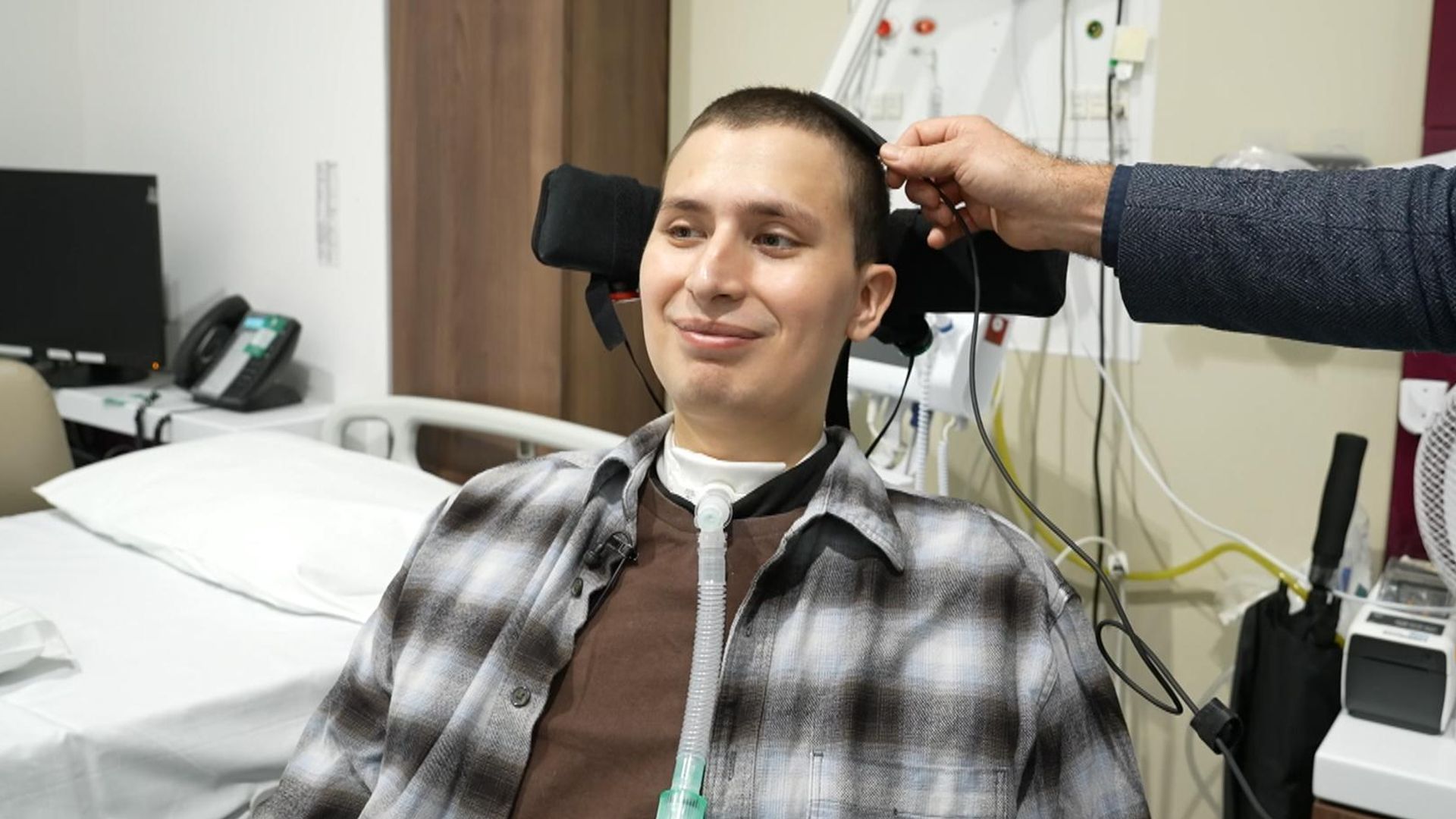
One of the first people in the UK to use Elon Musk’s brain chip says it “feels magical” and believes it could transform the lives of those with severe paralysis.
“It is a massive change in your life where you can suddenly no longer move any of your limbs,” said Sebastian Gomez-Pena, a volunteer in the first UK trial of the device developed by Mr Musk‘s company Neuralink.
“This kind of technology kind of gives you a new piece of hope.”
Seb had just completed his first term at medical school when an accident left him paralysed from the neck down.
He’s one of seven people fitted with the chip in the UK trial, designed to assess the safety and reliability of the device.
The Neuralink chip, which is linked to 1,024 electrodes implanted in his brain, was fitted in a five-hour operation at University College London Hospital (UCLH).
While British surgeons and engineers from Neuralink were involved, the device itself was implanted by Neuralink’s R1 robot – developed to insert the microscopic electrodes into fragile brain tissue.
The electrodes were inserted about 4mm into the surface of Seb’s brain, in the region that controls hand movements.
Nerve signals are carried via threads around 10-times thinner than a human hair to the chip, which is fitted into a circular hole in Seb’s skull.
Data from the chip is transferred wirelessly to a computer in which AI software “learns” to interpret the signals, translating Seb’s instructions to his hands that were cut off following his accident into the movement of a cursor on his laptop or phone.
“Everyone in my position tries to move some bit of their body to see if there is any form of recovery, but now when I think about moving my hand it’s cool to see that… something actually happens,” he said.
“You just think it and it does it.”
I watch as Seb’s cursor flies around the laptop screen, turning the pages of a research paper he’s studying for his medical school exams.
He highlights text, opens and closes windows as fast or faster than someone using a mouse or touchpad.
‘Mindblowing’ control
We meet Seb on the day his doctors are seeing him for the first time since he’s learned to use the device.
They’re brain surgeons, but seem as impressed as I am.
“It’s mindblowing – you can see the level of control that he has,” said Mr Harith Akram, a neurosurgeon at UCLH and lead investigator of the UK trial.
It is still early days. It’s taken Neuralink nearly 20 years to develop the chip and electrode technology, surgical robot and AI tools needed to satisfy regulators it’s in a position to test a device in humans.
The first device was implanted in a US volunteer two years ago; now 21 people in the US, Canada, UK and the UAE have one.
All have severe paralysis – either due to spinal injury, stroke, or neurodegenerative conditions such as ALS.
Results from the trials have yet to be published in peer-reviewed scientific journals or submitted to regulators. Neuralink agreed to give us access to the trial but declined to be interviewed.
However, in Mr Akram’s opinion, the early results are promising.
“This technology is going to be a game-changer for patients with severe neurological disability,” he said.
“Those patients have very little really to improve their independence. Especially now that we live in a world where we are so dependent on technology.”
Neuralink says its mission is to “restore autonomy to those with unmet medical needs and unlock new dimensions of human potential”.
Already some users have mastered the technology enough to type on a virtual keyboard by “thinking” about pressing keys with their fingers. Others have used the device to feed themselves with a robotic arm.
Alongside this trial targeting areas of the brain controlling movement, another is targeting brain regions involved in speech in the hope it can be restored in people who’ve lost the ability to talk following stroke or other brain injury.
Users could ‘inhabit’ a robot – Musk
The company also has plans to investigate reversing blindness by sending data from a cameras, via the chip, into the brain’s vision-processing centres.
Accessing other brain areas involves implanting electrodes deeper into the brain safely and reliably, a challenge the company admits it has yet to overcome.
Yet Elon Musk, Neuralink’s controversial founder, has greater hopes for the technology.
At an event last year, he floated the idea of users connecting their device to an Optimus robot made by his other company, Tesla.
“You should actually be able to have full body control and sensors from an Optimus robot. So you could basically inhabit an Optimus robot. It’s not just the hand. It’s the whole thing,” said Mr Musk.
“It’d be kind of cool. The future is going to be weird. But kind of cool.”
There’s no doubting the potential of this kind of technology for people with severe paralysis or “locked-in” syndrome, or perhaps one day, even blindness.
Read more from Sky News:
NHS lung cancer scheme ‘glimpse of the future’
Why is Ryanair fighting with Elon Musk?
Be the first to get Breaking News
Install the Sky News app for free
But it also raises important questions about future users’ safety and privacy.
Those remain a way off however.
Neuralink will need to do larger trials to show the devices are safe and reliable longer term before they could be licensed for wide use.
Unlike Elon Musk’s other engineering endeavours, this one depends on brave, determined volunteers like Seb to help deliver it.