Eighty years ago today, an American B-29 bomber dropped an atomic bomb on the Japanese city of Hiroshima.
It was the dawn of the atomic age, but the birth of the bomb can be traced beyond the deserts of New Mexico to Britain, five years earlier.
A copy of a hand-typed document, now in the Bodleian library in Oxford, is the first description of an atom bomb small enough to use as a weapon.
The Frisch-Peierls Memorandum was written by two nuclear physicists at the University of Birmingham in 1940.
Otto Frisch and Rudolf Peierls don’t feature in the film Oppenheimer, but their paper is credited with jump-starting the Manhattan Project that ultimately built the bomb.
Both Jewish scientists who had both fled Nazi Germany, they built on the latest understanding of uranium fission and nuclear chain reactions, to propose a bomb made from enriched uranium that was compact enough to be carried by an aircraft.
The document, so secret at the time only one copy was made, makes for chilling reading.
Not only does it detail how to build a bomb, but foretells the previously unimaginable power of its blast.
“Such an explosion would destroy life in a wide area,” they wrote.
“The size of this area is difficult to estimate, but it will probably cover the centre of a big city.”
Radioactive fallout would be inevitable “and even for days after the explosion any person entering the affected area will be killed”.
Both lethal properties of the bombs that would subsequently fall on Hiroshima and Nagasaki, killing around 100,000 instantly and more than 100,000 others in the years that followed – most of them civilians.
Read more:
Hiroshima survivor’s stark warning
The ‘destroyer of worlds’ who built the atomic bomb
‘The most terrifying weapons ever created’
Those bombs had the explosive power of around 16 and 20 kilotonnes of TNT respectively – a force great enough to end the Second World War.
But compared to nuclear weapons of today, they were tiny.
“What we would now term as low yield nuclear weapons,” said Alexandra Bell, president of the Bulletin of Atomic Scientists, which campaigns for nuclear disarmament.
“We’re talking about city destroyers…these really are the most terrifying weapons ever created.”
Many of these “high yield” nuclear weapons are thermonuclear designs first tested in the 1950s.
They use the power of nuclear fission that destroyed Hiroshima to harness yet more energy by fusing other atoms together.
Codenamed “Mike”, the first test of a fusion bomb in 1952 yielded at least 500 times more energy than those dropped on Japan.
Impractically devastating, but proof of lethal principle.
Variants of the W76 thermonuclear warhead currently deployed by the US and UK are around 100Kt, six times more powerful than the Hiroshima bomb.
Just one dropped on a city the size of London would result in more than a quarter of a million deaths.
The largest warhead in America’s current arsenal, the B83 has the explosive equivalent of 1.2 megatonnes (1.2 million tonnes of TNT) and would kill well over a million instantly.
But modern intercontinental ballistic missiles (ICBMs) are designed to carry multiple warheads.
Russia’s Sarmat 2, for example, is thought to be capable of carrying 10 megatonnes of nuclear payload.
They’re designed to strike multiple targets at once, but if all were dropped on a city like London most of its population of nine million would be killed or injured.
If that kind of power is incomprehensible, consider how many nuclear warheads there now are in the world.
Nine countries – the US, Russia, China, France, the UK, India, Pakistan, North Korea and Israel – have nuclear weapons.
Several others are interested in having them.
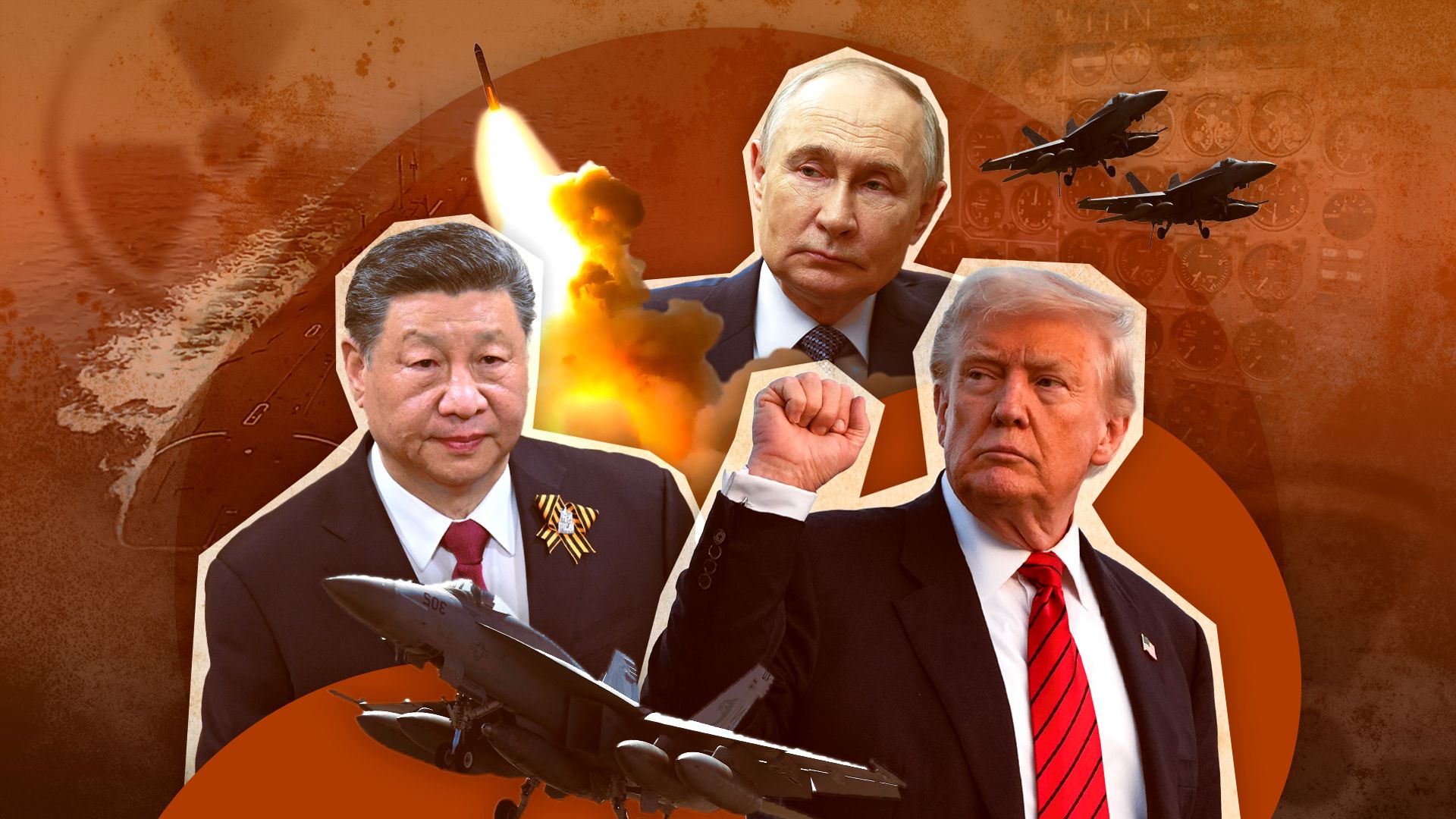
The US and Russia have around 4,000 nuclear warheads each – 90% of the global nuclear arsenal and more than enough to destroy civilisation.
According to analysis from the Stockholm International Peace Research Institute, China us thought to have around 600 warheads, but has indicated a desire to catch up.
Beijing is believed to be building up to 100 new warheads a year and the ICBMs to deliver them.
Five more nuclear powers, including the UK, plan to either increase or modernise their existing nuclear stockpiles.
The nuclear arms race that created this situation was one imagined by Frisch and Peierls in their 1940 memorandum.
Given the mass civilian casualties it would inevitably cause, the scientists questioned whether the bomb should ever be used by the Allies.
They wrote, however: “If one works on the assumption that Germany is, or will be, in the possession of this weapon… the most effective reply would be a counter-threat with a similar bomb.”
What they didn’t believe was that the bomb they proposed, and went on to help build at Los Alamos, would ever be used.
Devastated by its use on Japan, Peierls disavowed the bomb and later campaigned for disarmament.
But that work is now as unfinished as ever.
Non-proliferation treaties helped reduce the expensive and excessive nuclear arsenals of Russia and the US, and prevent more countries from building nuclear bombs.
‘Everything trending in the wrong direction’
But progress ground to a halt with the invasion of Ukraine, as nuclear tensions continued elsewhere.
“After all the extremely hard, tedious work that we did to reduce nuclear risks everything is now trending in the wrong direction,” said Alexandra Bell.
“The US and Russia refuse to talk to each other about strategic stability.
“China is building up its nuclear arsenal in an unprecedented fashion and the structures that were keeping non-proliferation in place stemming the spread of nuclear weapons are crumbling around us.”
‘New risks increasing the threat’
The world may have come closer to nuclear conflict during the Cuban missile crisis of 1963, but the fragmented and febrile state of geopolitics now is more dangerous, she argues.
Conflict regularly flares between nuclear armed India and Pakistan; Donald Trump’s foreign policy has sparked fears that South Korea might pursue the bomb to counter North Korea’s nuclear threat; some states in the Middle East are eyeing a nuclear deterrent to either nuclear-wannabe Iran or nuclear armed Israel.
Add to the mix the military use of AI and stressors like climate change, and the view of the Bulletin of Atomic Scientists is the situation is more precarious than in 1963.
“It’s more dangerous, but in a different way,” said Alexandra Bell. “The confluence of all these new existential risks are increasing the threat worldwide.”