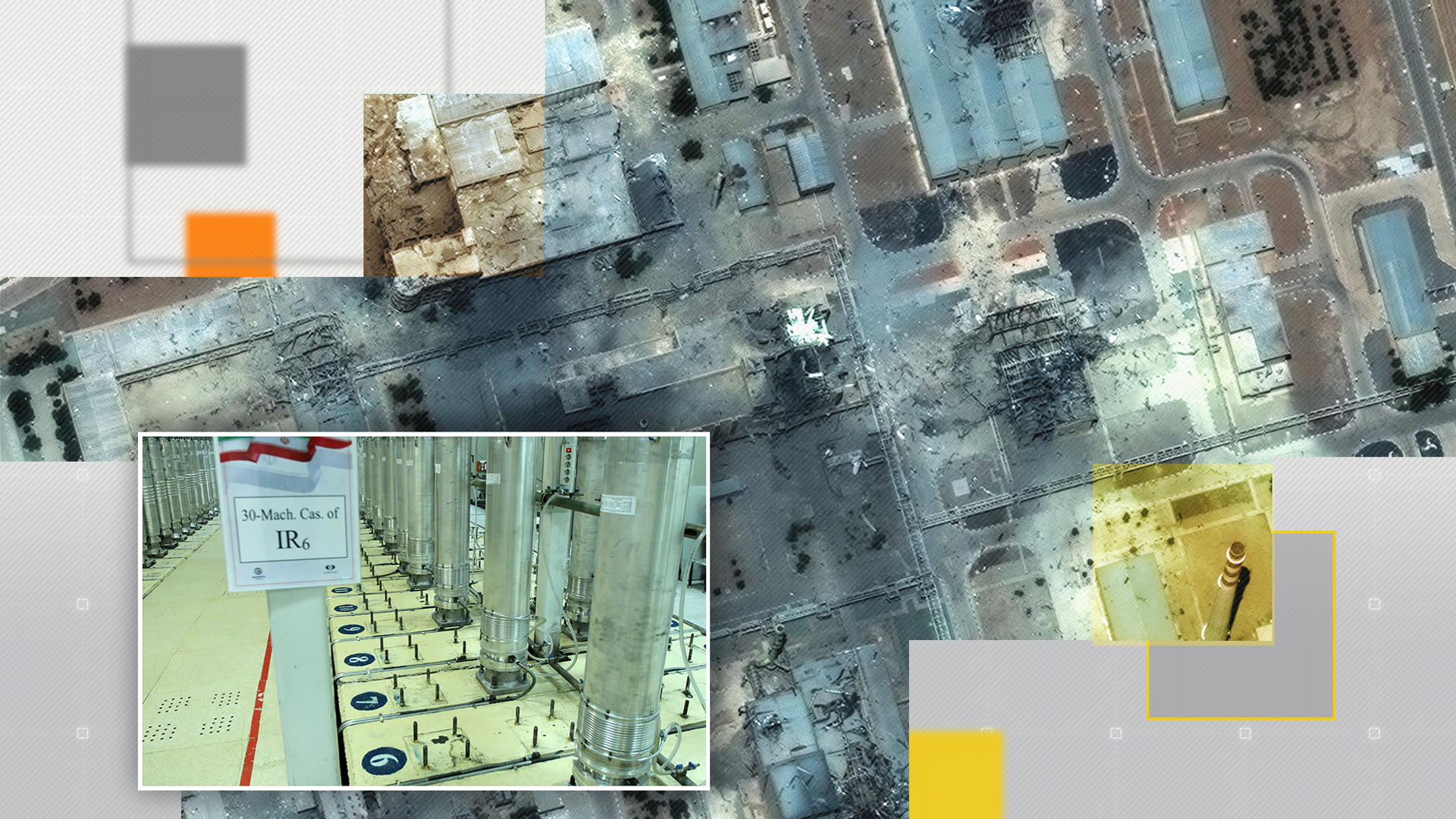
It was one of the most sophisticated bombing campaigns in history.
But an analysis of the sites targeted by US and Israeli strikes on Iran suggests they may have been deliberately limited to avoid widespread radioactive contamination and the international condemnation that would almost certainly follow.
The stated aim of the bombing raids was to eliminate the potential threat to Israel and the wider Middle East of a nuclear-armed Iran.
US and Israeli forces targeted seven key facilities associated with Iran’s nuclear programme.
But despite their scale, the attacks weren’t comprehensive.
At least 10 sites associated with Iran’s nuclear capability were apparently untouched.
Some may have been spared because they weren’t considered an imminent threat.
Facilities like the Lashkar Ab’ad nuclear enrichment plant.
A decade ago it was involved in the faster, but technically challenging method of using lasers rather than centrifuges to enrich uranium.
But Iran seems instead to have invested far more effort in using the slower, but more well-understood method that uses centrifuges to spin a gaseous form of uranium – uranium hexafluoride – to enrich it.
Perhaps making Lashkar Ab’ad not worth the cost of an expensive bomb or missile.
Then there’s the Mt. Kolang Gaz La complex.
Based on our assessment of the latest satellite images, the underground complex immediately adjacent to the Natanz nuclear facility also wasn’t targeted.
Perhaps because it is still under construction. However, once it is complete, and if, as most analysts assume, Iran’s stockpile of highly enriched uranium escaped destruction in the raids, it would be a very good place to hide it.
Read more: Israel-Iran latest updates
The mountain of Kolang Gaz La is far higher than the one sheltering the recently attacked Fordow facility. If the tunnel complex being built beneath it is completed, it would be a far more challenging target for America’s bunker-busting bombs.
But other sites may well have been spared to avoid a national, potentially international, nuclear disaster.
Nearly all the sites hit were involved with Uranium enrichment, like the centrifuge facilities at Natanz and Fordow.
And while uranium is radioactive, targeting enrichment facilities doesn’t pose the same radioactive risk as other processes.
Uranium is very heavy. Even if hoisted into the air by a bomb – it quickly falls to the ground.
Read more: How much damage has been done to Iran’s nuclear facilities?
“If you were to expose uranium hexafluoride to the atmosphere, then it reacts with the water and the uranium drops out,” said Prof Laurence Williams, former UK chief inspector of nuclear installations.
Although it would be dangerous to anyone close – the other part of the reaction forms hydrofluoric acid which is incredibly toxic – the radioactive uranium would effectively stay close to where it started.
Follow our channel and never miss an update
Nuclear reactors are a very different story.
While operating, reactors contain a complex soup of radioactive elements.
Some of these, like strontium, caesium and iodine are lightweight, or volatile, as well as highly radioactive.
“If they escape, then they’re going to get into the atmosphere,” said Prof Williams. “If you’ve a force, like in the case of Chernobyl, where you had a fire which was elevating the volatiles, then they get into [the] atmosphere and then get distributed by normal atmospheric dispersion.”
In short, bombing a nuclear reactor would lead to potentially widespread nuclear contamination certainly nearby, and potentially beyond Iran’s borders.
For this reason, Israeli and US commanders may have deliberately avoided targeting them.
At Isfahan for example, Israeli, and then American, raids destroyed multiple buildings linked to Uranium enrichment. But neither hit buildings that house small research reactors on the site.
The same goes for the Bushehr Nuclear Power Plant in the south of Iran, and the Tehran Nuclear Research Reactor located in the capital city.
But reactors are important if Iran were to be pursuing a nuclear weapon.
During operation, most designs produce plutonium as a by-product. Perfect for making nuclear bombs.
Please use Chrome browser for a more accessible video player
Be the first to get Breaking News
Install the Sky News app for free
And making plutonium in a reactor is much faster than enriching uranium using centrifuges.
And this probably explains why Israel bombed Iran’s Arak Heavy Water Reactor, which would have been capable of making 9kg of plutonium a year.
The likely reason they did is because the reactor was in the process of being rebuilt and contained no fuel – and therefore there was no risk of nuclear disaster.
Listen to The World with Richard Engel and Yalda Hakim every Wednesday
All this goes to show these recent strikes may well have been a compromise.
The UN nuclear watchdog, the International Atomic Energy Agency, warned both Israel and America of the danger of targeting nuclear sites.
While America and Israel may have wanted to wipe out Iran’s nuclear ambitions, the risk of civilian casualties exposed to radioactive fallout from bombing and the international outcry that would create, left them pulling their punches.
Additional reporting by Data and Forensics journalists Kaitlin Tosh and Sophia Massam, OSINT Editor Adam Parker, and OSINT producer Freya Gibson.